Catena is now Pearl Talent! Same mission, new name.
The job title you give your executive assistant shapes how the role is perceived internally, how candidates evaluate the opportunity, and how clearly responsibilities are understood across your org. A vague or outdated title creates confusion. A precise one signals scope, seniority, and strategic value.
This list breaks down 25 executive assistant job titles, what each one actually covers, and how to match the right title to the role you're building. Whether you're hiring your first EA or restructuring an existing team, you'll walk away with a clear framework for choosing titles that reflect real responsibilities.
Job titles are one of those things that seem purely cosmetic until they start affecting how people interact with the role. The title you assign to your EA influences who applies for the role, how the rest of the team perceives them, and whether the person in the role feels like their work is accurately represented.
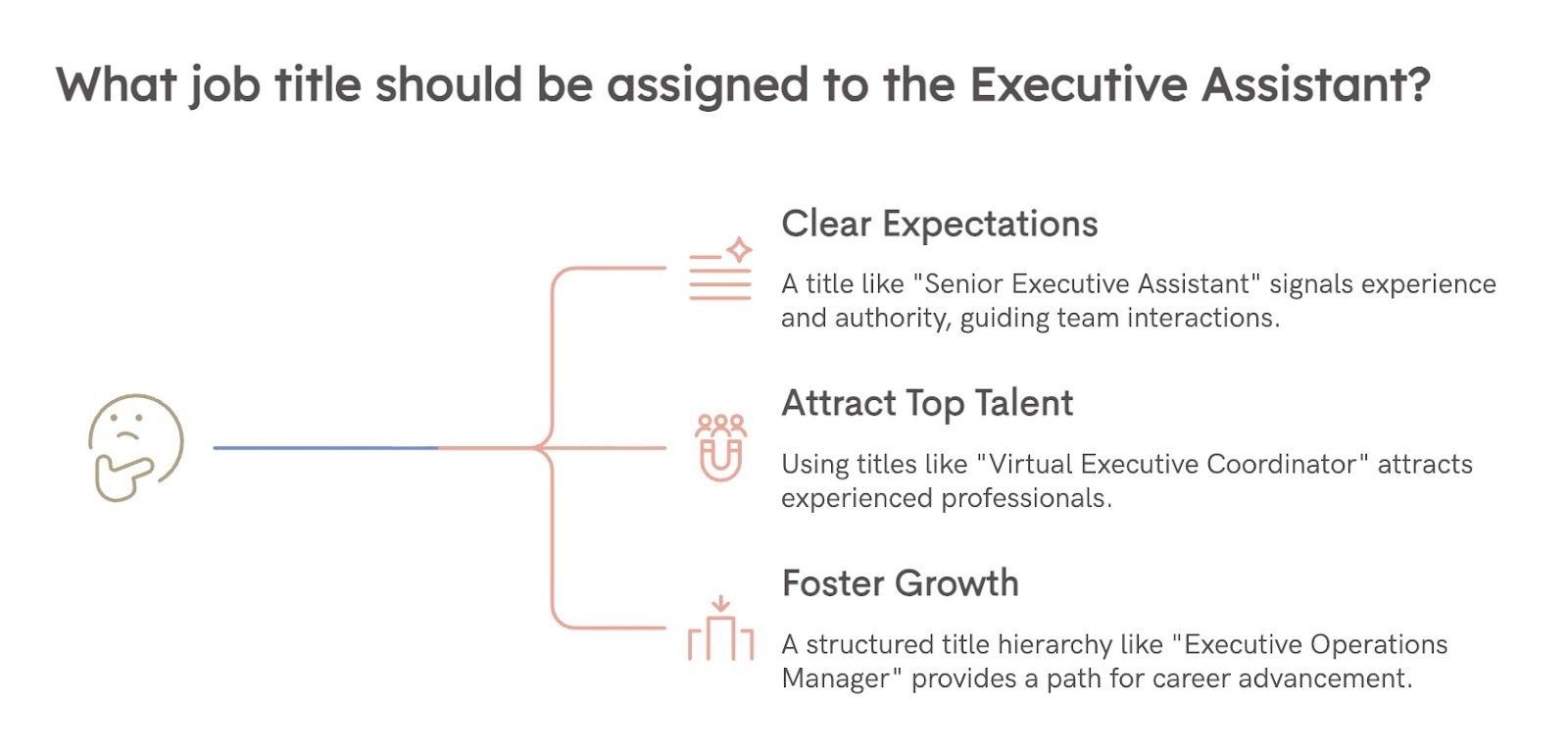
When someone's title clearly communicates their scope, other teams know how to engage with them. A "Senior Executive Assistant" signals experience and authority. An "Administrative Coordinator" suggests someone managing internal logistics. Without that clarity, you end up with a common problem: other departments either undervalue the EA's involvement or give them work that falls outside their actual responsibilities.
A clear title acts like a shorthand job description. It reduces the back-and-forth of "is this something you handle?" and lets your EA operate with more autonomy from day one.
Think about it from the candidate's side. Someone with seven years of experience supporting C-suite executives isn't going to get excited about a listing titled "Admin Assistant." They'll scroll past it, even if the actual role involves strategic planning, cross-functional coordination, and budget oversight.
The candidates you miss by using a generic title:
The title is the first filter in your hiring funnel. Make it count.
One of the fastest ways to lose a great EA is to make them feel like they've hit a ceiling. If the role is just called "Executive Assistant" even when the person in that role has grown over the years, there's no signal that their growing responsibilities are being recognized.
A structured title hierarchy changes that. For example, a progression might look like moving from Executive Assistant to Senior Executive Assistant to Executive Operations Manager to Chief of Staff. Each step reflects a real expansion in scope, not just a tenure milestone. That kind of clarity gives your EA something to work toward and gives you a retention lever that doesn't require constant salary bumps to be effective.
The right pick depends on what the role actually involves day to day, who the EA reports to, and how much autonomy they carry. Here's a breakdown of 25 titles for executive assistants, along with what each one signals to candidates and to the rest of your org.
The most widely recognized title in this space, and still the right choice when the role is a clean match for traditional EA responsibilities.
This person manages an executive's calendar, handles correspondence, coordinates travel, and acts as the first point of contact for internal and external communications. It works best when the scope is clearly tied to supporting one or two senior leaders rather than managing broader operations. If the role stays within those boundaries, there's no need to overcomplicate the title.
This title signals depth of experience and a wider scope of responsibility than a standard EA. A Senior EA typically supports C-suite executives, manages confidential information, and mentors junior administrative staff.
What tends to separate this role from a regular EA:
It's the right title when someone has been in the function long enough to operate independently and take on responsibilities that go beyond day-to-day coordination.
An executive coordinator leans more toward process and workflow management than direct executive support. Where an EA is typically anchored to a specific person, a coordinator often works across teams to make sure initiatives stay on track, meetings are productive, and nothing falls through the cracks.
This title fits well in fast-moving environments where the role is less about gatekeeping an executive's time and more about keeping the operational engine running. Think of it as the connective tissue between leadership decisions and team execution.
This role is focused on the logistics that keep an office or team functioning smoothly. Scheduling, supply management, vendor coordination, event planning, and internal communications all fall under this umbrella. It's less about supporting a single executive and more about maintaining the rhythm of daily operations.
An administrative coordinator is a strong fit when:
This title makes sense when the EA is genuinely involved in decision-making, not just executing tasks. A strategic assistant sits in on leadership meetings, synthesizes information from across the business, and helps executives prioritize based on data rather than gut feel. They're often the person preparing the brief before a board meeting or flagging a market trend that hasn't hit the leadership team's radar yet.
It's a title that should be used carefully. If the role is primarily administrative with occasional strategic input, calling it "strategic" oversells the position and creates misaligned expectations for candidates.
A slight expansion of the classic EA title, this version signals that the role carries heavier administrative weight. The person in this seat handles document management, correspondence, travel, and scheduling, but often for multiple executives or across a broader organizational scope.
It's a good middle ground when the responsibilities are clearly administrative but the volume and complexity go beyond what a standard EA listing would suggest. Particularly common in larger organizations where administrative support is structured into tiers.
Built for remote-first companies, the virtual support coordinator or virtual assistant title reflects an EA role that operates entirely through digital tools. Calendar management, inbox triage, CRM updates, project tracking in platforms like Asana or Monday.com, and async communication across time zones are all core to the role.
If your team is distributed and the role won't involve any in-person responsibilities, this title immediately tells candidates that they won't have to be present in the office and can work remotely.
This is the most senior evolution of the EA function, and it's a fundamentally different role. A Chief of Staff operates as an extension of the CEO or founder, managing cross-functional priorities, running leadership meetings, translating strategy into execution plans, and often making decisions on the executive's behalf.
It's not an inflated EA title. Companies that use it correctly are hiring someone to own organizational alignment at the highest level. The role typically requires experience in operations, strong business judgment, and the ability to work across every department without formal authority over any of them. If your EA is already functioning at this level, the title should reflect it.
This title bridges executive support and office operations. The person manages the physical or virtual workspace, oversees administrative staff, handles budgets for office operations, and ensures the environment runs efficiently. They're often the go-to person when something needs to get done, and no one else clearly owns it.
A strong fit for companies where the EA has naturally absorbed office management responsibilities and the role has outgrown a pure support title.
An operations coordinator focuses on systems, processes, and workflow efficiency. They work closely with leadership to identify bottlenecks, implement tools, and make sure teams have what they need to execute. The title works when the EA role has shifted away from personal executive support and toward making the broader organization run better.
Day-to-day, this often looks like:
This role combines administrative support with a real understanding of the business itself. An executive business administrator doesn't just manage logistics. They track financial reports, help prepare investor updates, coordinate between departments on strategic initiatives, and often serve as the person who knows where every project stands at any given time.
It's a title that signals the person needs both administrative precision and business acumen. Particularly common in startups and mid-size companies, where the EA is expected to understand revenue, burn rate, and growth priorities alongside calendar management.
Where a generalist EA handles whatever comes across the desk, an executive operations specialist is brought in to improve how things work. They audit existing workflows, recommend tools or process changes, and help leadership implement systems that reduce friction across the org.
This title fits when the role is less reactive and more proactive. The person isn't just keeping up with daily tasks. They're actively looking for ways to make the executive's function, and by extension the broader team, operate more efficiently.
Some EA roles evolve to the point where the person is essentially running projects end to end. An executive project manager owns timelines, coordinates deliverables across teams, manages stakeholder communication, and reports progress directly to leadership.
This title is appropriate when:
If the role is more about managing an executive's day than managing projects, this title will attract the wrong candidates.
A C-suite coordinator serves as the organizational hub for the entire executive team rather than a single leader. They manage schedules across multiple executives, coordinate leadership meetings, handle board communications, and make sure the C-suite operates as a cohesive unit.
The scope is inherently broader than a traditional EA role. This person needs to balance competing priorities from several leaders, exercise strong judgment about what gets escalated, and maintain confidentiality across multiple sensitive workstreams simultaneously.
This title reflects a role centered on relationship management. The person manages interactions between the executive and key stakeholders, including investors, clients, board members, and strategic partners. They handle meeting prep, follow-up communications, and often track the status of important external relationships.
It's a less common title but a highly specific one. If a significant portion of the role involves managing who the executive meets with, preparing them for those conversations, and following up afterward, this title describes it accurately.
An executive support manager leads a team of EAs or administrative professionals rather than functioning as an individual contributor. They set standards, manage workload distribution, handle hiring for the support function, and ensure executives across the org are getting consistent, high-quality assistance.
What this role typically owns:
This title only makes sense when there's actually a team to manage. For a solo EA, it overstates the role.
This is a senior-level title for someone who advises leadership on administrative strategy and organizational efficiency. They're not handling scheduling or travel. Instead, they're shaping how administrative functions are structured across the company, mentoring other administrative professionals, and consulting with executives on how to optimize their support infrastructure.
It's a niche title best suited for large organizations with mature administrative functions that need senior guidance rather than hands-on support.
Similar to an engagement manager but with a broader mandate, this role focuses on building and maintaining the executive's professional network. They manage outreach, coordinate with external organizations, handle event attendance and speaking engagements, and track relationship health across the executive's key contacts.
The role works best when networking, partnerships, and external visibility are central to the executive's function. Particularly relevant for CEOs, founders, and executives in business development-heavy roles.
A business facilitator focuses on making collaboration happen. They plan and run meetings, align cross-functional teams, document decisions, and ensure follow-through on action items. The emphasis is less on supporting one person and more on making groups of people work together effectively.
This title fits when the role has a heavy meeting management and cross-team coordination component. The person isn't just booking conference rooms. They're designing agendas, facilitating discussions, and making sure nothing agreed upon in a meeting gets lost the next day.
An administrative strategist looks at the bigger picture of how administrative work is done across the organization and finds ways to improve it. They evaluate tools, redesign processes, and build systems that reduce manual work and improve efficiency.
This title is appropriate when the person is spending more time optimizing than executing. If they're the ones recommending that the team switch from manual scheduling to a tool like Calendly, or proposing a new filing system that saves the operations team hours each week, "strategist" captures the role accurately.
This is a leadership title for someone overseeing the entire operational support function around senior leadership. They manage teams, set strategy for how executives are supported, and often have a seat at the table when organizational decisions are made.
The role typically includes:
Reserve this title for roles with genuine leadership scope and direct reports.
A generalist title for someone who handles a wide range of office and executive support tasks. Research, event planning, document preparation, vendor management, and light project coordination all fall within scope. It's a good fit when the role requires adaptability and a broad skill set rather than deep specialization in any one area.
This works particularly well in smaller organizations where the person needs to wear multiple hats without the role being heavily strategic or leadership-oriented.
This title signals a problem-solving orientation. An executive solutions manager is brought in when leadership needs someone who can identify inefficiencies, develop fixes, and implement changes. They're less about maintaining systems and more about improving them.
The distinction from similar titles like "operations specialist" is the scope. A solutions manager typically works on bigger, more complex challenges. Restructuring how information flows between departments. Fixing a broken onboarding process. Building a reporting framework that didn't exist before. The title works when the role is defined by solving problems rather than managing routines.
The CAO oversees all administrative functions across an organization. This is a true executive-level role with responsibility for operational infrastructure, administrative teams, compliance-related administrative processes, and often facilities management. They report directly to the CEO and play a key role in how the company runs at a structural level.
This title belongs in organizations large enough to warrant a dedicated executive for administrative operations. It's not a progression from EA. It's a distinct leadership function.
This title is straightforward about the nature of the role. An executive personal assistant handles both professional and personal tasks for a senior leader. Calendar management and meeting coordination sit alongside personal errands, household logistics, travel planning for personal trips, and managing private correspondence.
It's a title that works when the boundaries between work and personal support are intentionally blurred, which is common with founders and CEOs who need a single person managing their entire life, not just their work schedule. Being upfront about the personal component in the title helps attract candidates who are comfortable with that scope rather than surprising them after they start.
You can get the title right and still end up with the wrong person in the seat. A "Chief of Staff" who can't run a cross-functional meeting or an "Executive Operations Specialist" who needs hand-holding on basic workflows costs you more than a bad hire. It costs you the time you were supposed to get back.
The typical EA hiring process makes finding that match harder than it needs to be. You post a listing, get hundreds of applications, and spend weeks screening and interviewing. If the hire doesn't work out, you've lost a month or more, and you're starting over from scratch.
That's largely a sourcing and vetting problem. If the candidates reaching your desk were already filtered for the right skill level, communication ability, and role fit, most of that wasted time disappears. Pearl Talent is built around that idea.
Pearl Talent places executive assistants, senior EAs, Chiefs of Staff, and operations coordinators from the Philippines, Latin America, and South Africa. Every role is headhunted individually, sourced from top local companies and universities rather than traditional outsourcing talent pools. You're not sorting through a pile of resumes. You're evaluating candidates who have already been screened for the scope you need.
What you get when you hire through Pearl Talent:
Our candidates are already vetted and ready to hire. Browse available executive assistants.

.svg)